Fall ’26 Department Seminars with Dr. Patrick Damacet
Title: Probing Host-Guest Interactions in Conductive Frameworks for the Detection and Remediation of Environmental Pollutants
Speaker: Dr. Patrick Damacet
Date: 27/10/2026, Tuesday
Time: 12:30 (Turkiye Time)
Place: Departmental Seminar Room (SBZ-14)
Abstract:
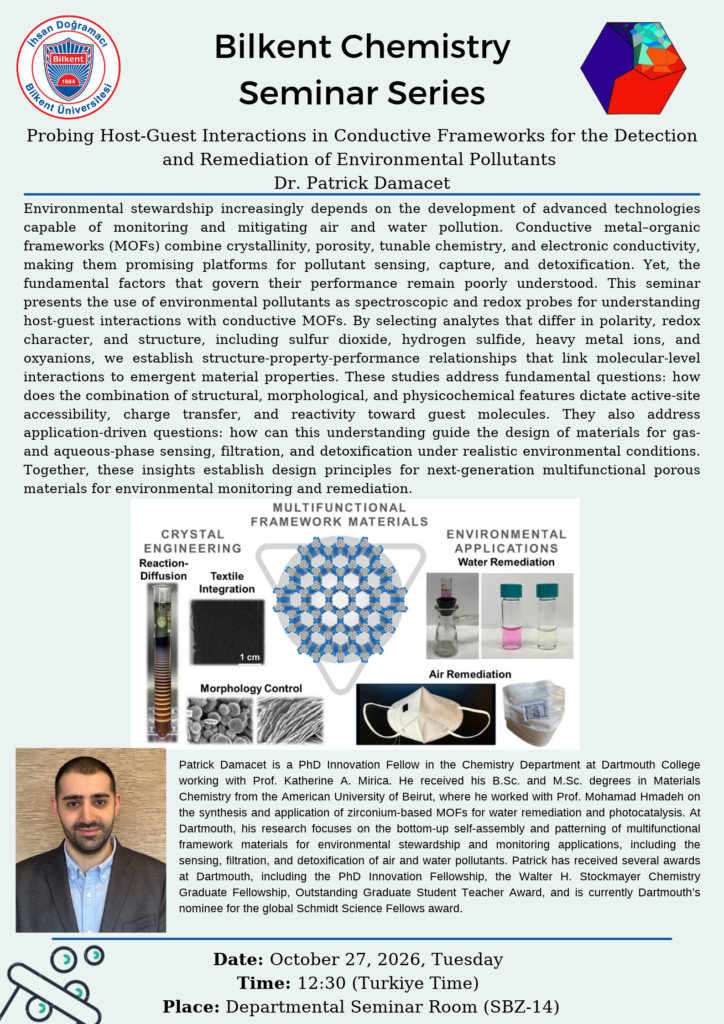
Environmental stewardship increasingly depends on the development of advanced technologies capable of monitoring and mitigating air and water pollution. Conductive metal–organic frameworks (MOFs) combine crystallinity, porosity, tunable chemistry, and electronic conductivity, making them promising platforms for pollutant sensing, capture, and detoxification. Yet, the fundamental factors that govern their performance remain poorly understood. This seminar presents the use of environmental pollutants as spectroscopic and redox probes for understanding host-guest interactions with conductive MOFs. By selecting analytes that differ in polarity, redox character, and structure, including sulfur dioxide, hydrogen sulfide, heavy metal ions, and oxyanions, we establish structure-property-performance relationships that link molecular-level interactions to emergent material properties. These studies address fundamental questions: how does the combination of structural, morphological, and physicochemical features dictate active-site accessibility, charge transfer, and reactivity toward guest molecules. They also address application-driven questions: how can this understanding guide the design of materials for gas- and aqueous-phase sensing, filtration, and detoxification under realistic environmental conditions. Together, these insights establish design principles for next-generation multifunctional porous materials for environmental monitoring and remediation.
Short Biography of the Speaker:
Patrick Damacet is a PhD Innovation Fellow in the Chemistry Department at Dartmouth College working with Prof. Katherine A. Mirica. He received his B.Sc. and M.Sc. degrees in Materials Chemistry from the American University of Beirut, where he worked with Prof. Mohamad Hmadeh on the synthesis and application of zirconium-based MOFs for water remediation and photocatalysis. At Dartmouth, his research focuses on the bottom-up self-assembly and patterning of multifunctional framework materials for environmental stewardship and monitoring applications, including the sensing, filtration, and detoxification of air and water pollutants. Patrick has received several awards at Dartmouth, including the PhD Innovation Fellowship, the Walter H. Stockmayer Chemistry Graduate Fellowship, Outstanding Graduate Student Teacher Award, and is currently Dartmouth’s nominee for the global Schmidt Science Fellows award.