Fall ’26 Department Seminars with Dr. Basit Yameen
Title: Rational Design of Double Cable Organic Semiconducting Polymers and Their Functional Hybrids as Photocatalysts for Artificial Photosynthesis
Speaker: Dr. Basit Yameen
Date: 04/11/2026, Wednesday
Time: 12:30 (Turkiye Time)
Place: Departmental Seminar Room (SBZ-14)
Abstract:
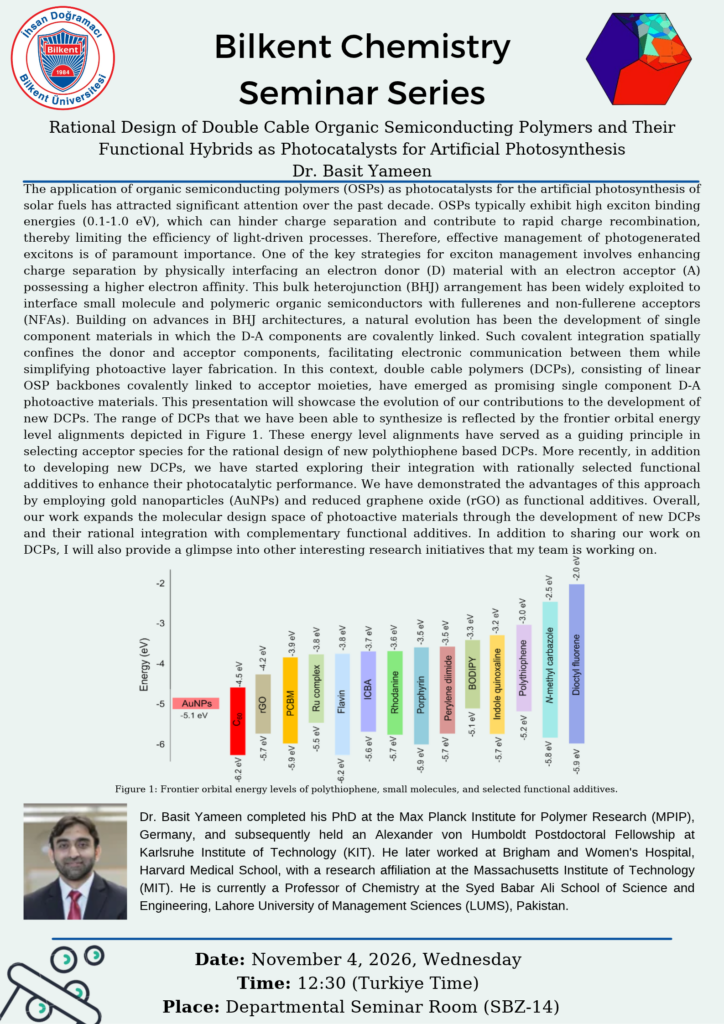
The application of organic semiconducting polymers (OSPs) as photocatalysts for the artificial photosynthesis of solar fuels has attracted significant attention over the past decade. OSPs typically exhibit high exciton binding energies (0.1-1.0 eV), which can hinder charge separation and contribute to rapid charge recombination, thereby limiting the efficiency of light-driven processes. Therefore, effective management of photogenerated excitons is of paramount importance. One of the key strategies for exciton management involves enhancing charge separation by physically interfacing an electron donor (D) material with an electron acceptor (A) possessing a higher electron affinity. This bulk heterojunction (BHJ) arrangement has been widely exploited to interface small molecule and polymeric organic semiconductors with fullerenes and non-fullerene acceptors (NFAs). Building on advances in BHJ architectures, a natural evolution has been the development of single component materials in which the D-A components are covalently linked. Such covalent integration spatially confines the donor and acceptor components, facilitating electronic communication between them while simplifying photoactive layer fabrication. In this context, double cable polymers (DCPs), consisting of linear OSP backbones covalently linked to acceptor moieties, have emerged as promising single component D-A photoactive materials. This presentation will showcase the evolution of our contributions to the development of new DCPs. The range of DCPs that we have been able to synthesize is reflected by the frontier orbital energy level alignments depicted in Figure 1. These energy level alignments have served as a guiding principle in selecting acceptor species for the rational design of new polythiophene based DCPs. More recently, in addition to developing new DCPs, we have started exploring their integration with rationally selected functional additives to enhance their photocatalytic performance. We have demonstrated the advantages of this approach by employing gold nanoparticles (AuNPs) and reduced graphene oxide (rGO) as functional additives. Overall, our work expands the molecular design space of photoactive materials through the development of new DCPs and their rational integration with complementary functional additives. In addition to sharing our work on DCPs, I will also provide a glimpse into other interesting research initiatives that my team is working on.
Short Biography of the Speaker:
Dr. Basit Yameen completed his PhD at the Max Planck Institute for Polymer Research (MPIP), Germany, and subsequently held an Alexander von Humboldt Postdoctoral Fellowship at Karlsruhe Institute of Technology (KIT). He later worked at Brigham and Women’s Hospital, Harvard Medical School, with a research affiliation at the Massachusetts Institute of Technology (MIT). He is currently a Professor of Chemistry at the Syed Babar Ali School of Science and Engineering, Lahore University of Management Sciences (LUMS), Pakistan.