Fall ’26 Department Seminars with Prof. Scott Reed
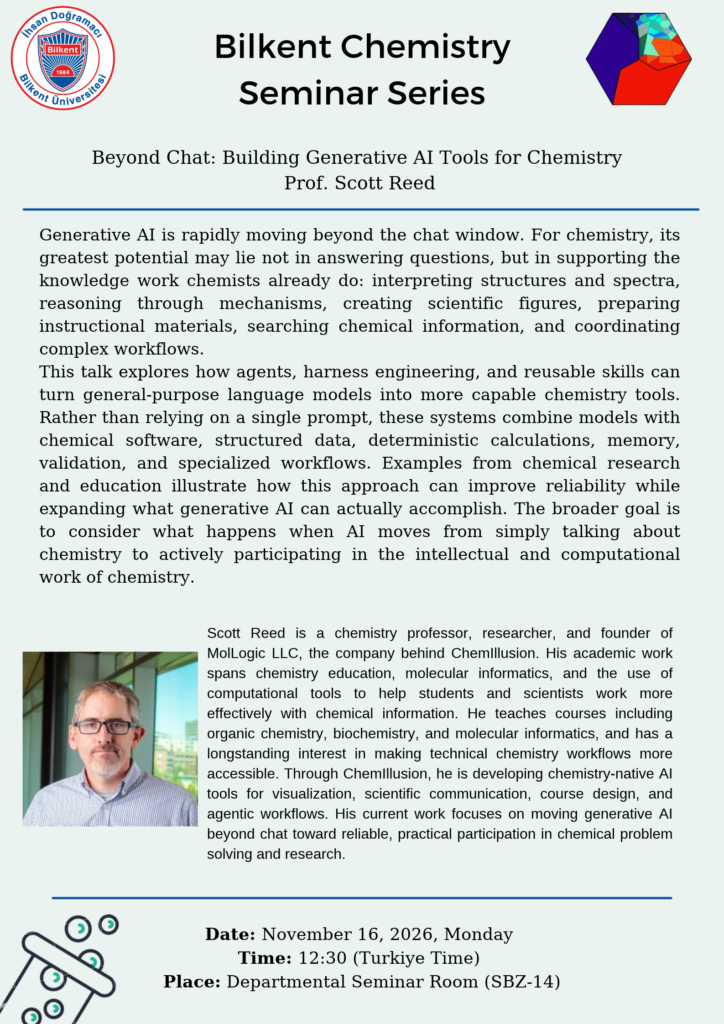
Title: Beyond Chat: Building Generative AI Tools for Chemistry
Speaker: Prof. Scott Reed
Date: 16/11/2026, Monday
Time: 12:30 (Turkiye Time)
Place: Departmental Seminar Room (SBZ-14)
Abstract:
Generative AI is rapidly moving beyond the chat window. For chemistry, its greatest potential may lie not in answering questions, but in supporting the knowledge work chemists already do: interpreting structures and spectra, reasoning through mechanisms, creating scientific figures, preparing instructional materials, searching chemical information, and coordinating complex workflows.
This talk explores how agents, harness engineering, and reusable skills can turn general-purpose language models into more capable chemistry tools. Rather than relying on a single prompt, these systems combine models with chemical software, structured data, deterministic calculations, memory, validation, and specialized workflows. Examples from chemical research and education illustrate how this approach can improve reliability while expanding what generative AI can actually accomplish. The broader goal is to consider what happens when AI moves from simply talking about chemistry to actively participating in the intellectual and computational work of chemistry.
Short Biography of the Speaker:
Scott Reed is a chemistry professor, researcher, and founder of MolLogic LLC, the company behind ChemIllusion. His academic work spans chemistry education, molecular informatics, and the use of computational tools to help students and scientists work more effectively with chemical information. He teaches courses including organic chemistry, biochemistry, and molecular informatics, and has a longstanding interest in making technical chemistry workflows more accessible. Through ChemIllusion, he is developing chemistry-native AI tools for visualization, scientific communication, course design, and agentic workflows. His current work focuses on moving generative AI beyond chat toward reliable, practical participation in chemical problem solving and research.