Fall ’26 Department Seminars with Dr. Ali Tuna
Title: Functional Molecular Chemistry and Analytics: From Molecular Design to Sustainable Energy Conversion and Storage
Speaker: Dr. Ali Tuna
Date: 20/10/2026, Tuesday
Time: 12:30 (Turkiye Time)
Place: Departmental Seminar Room (SBZ-14)
Abstract:
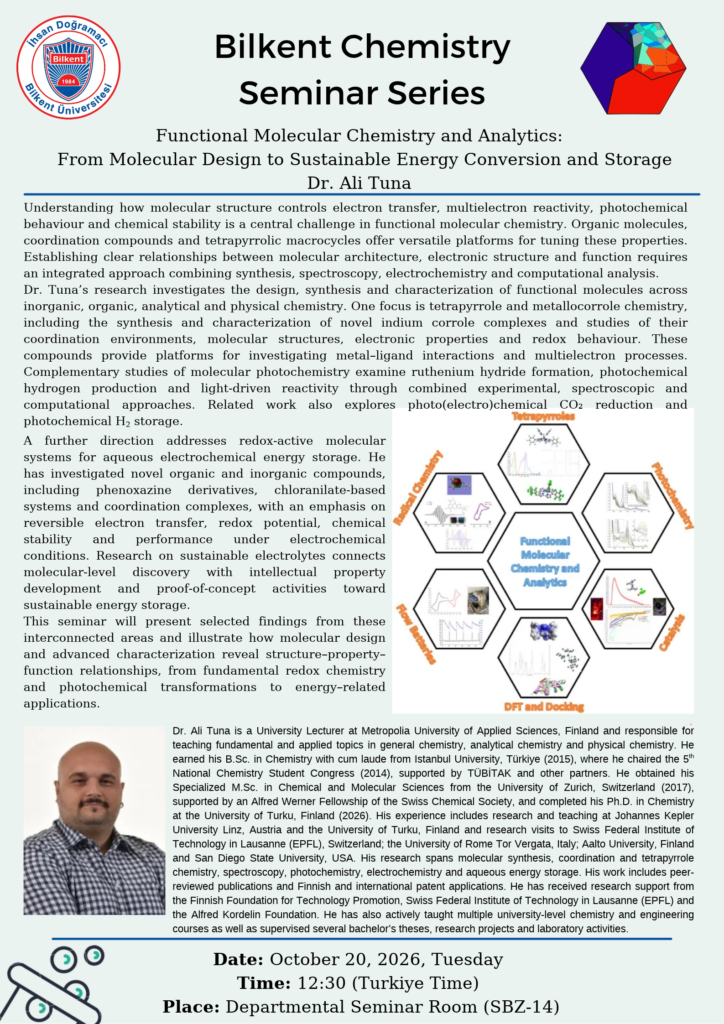
Understanding how molecular structure controls electron transfer, multielectron reactivity, photochemical behaviour and chemical stability is a central challenge in functional molecular chemistry. Organic molecules, coordination compounds and tetrapyrrolic macrocycles offer versatile platforms for tuning these properties. Establishing clear relationships between molecular architecture, electronic structure and function requires an integrated approach combining synthesis, spectroscopy, electrochemistry and computational analysis.
Dr. Tuna’s research investigates the design, synthesis and characterization of functional molecules across inorganic, organic, analytical and physical chemistry. One focus is tetrapyrrole and metallocorrole chemistry, including the synthesis and characterization of novel indium corrole complexes and studies of their coordination environments, molecular structures, electronic properties and redox behaviour. These compounds provide platforms for investigating metal–ligand interactions and multielectron processes. Complementary studies of molecular photochemistry examine ruthenium hydride formation, photochemical hydrogen production and light-driven reactivity through combined experimental, spectroscopic and computational approaches. Related work also explores photo(electro)chemical CO₂ reduction and photochemical H2 storage.
A further direction addresses redox-active molecular systems for aqueous electrochemical energy storage. He has investigated novel organic and inorganic compounds, including phenoxazine derivatives, chloranilate-based systems and coordination complexes, with an emphasis on reversible electron transfer, redox potential, chemical stability and performance under electrochemical conditions. Research on sustainable electrolytes connects molecular-level discovery with intellectual property development and proof-of-concept activities toward sustainable energy storage.
This seminar will present selected findings from these interconnected areas and illustrate how molecular design and advanced characterization reveal structure–property–function relationships, from fundamental redox chemistry and photochemical transformations to energy–related applications.
Short Biography of the Speaker:
Dr. Ali Tuna is a University Lecturer at Metropolia University of Applied Sciences, Finland and responsible for teaching fundamental and applied topics in general chemistry, analytical chemistry and physical chemistry. He earned his B.Sc. in Chemistry with cum laude from Istanbul University, Türkiye (2015), where he chaired the 5th National Chemistry Student Congress (2014), supported by TÜBİTAK and other partners. He obtained his Specialized M.Sc. in Chemical and Molecular Sciences from the University of Zurich, Switzerland (2017), supported by an Alfred Werner Fellowship of the Swiss Chemical Society, and completed his Ph.D. in Chemistry at the University of Turku, Finland (2026). His experience includes research and teaching at Johannes Kepler University Linz, Austria and the University of Turku, Finland and research visits to Swiss Federal Institute of Technology in Lausanne (EPFL), Switzerland; the University of Rome Tor Vergata, Italy; Aalto University, Finland and San Diego State University, USA.
His research spans molecular synthesis, coordination and tetrapyrrole chemistry, spectroscopy, photochemistry, electrochemistry and aqueous energy storage. His work includes peer-reviewed publications and Finnish and international patent applications. He has received research support from the Finnish Foundation for Technology Promotion, Swiss Federal Institute of Technology in Lausanne (EPFL) and the Alfred Kordelin Foundation. He has also actively taught multiple university-level chemistry and engineering courses as well as supervised several bachelor’s theses, research projects and laboratory activities.